Store security audit from the server side
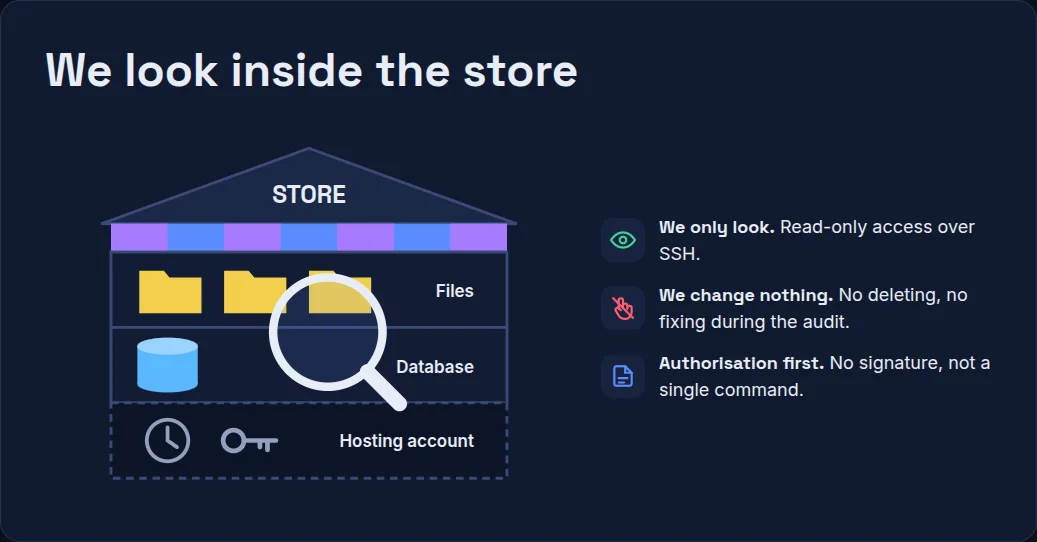
We check the store's files, database and hosting account for signs of intrusion, hidden backdoors and scripts that steal data at checkout. We compare the core with a clean CS-Cart of the same version and look for files that should not be reachable from the internet. We change nothing on the server, and the report lists every finding with its severity and a ready-made fix.
We audit only under written authorisation from a person entitled to decide about the store and its hosting account. We work in English and Polish.
Why the hosting scanner is not enough
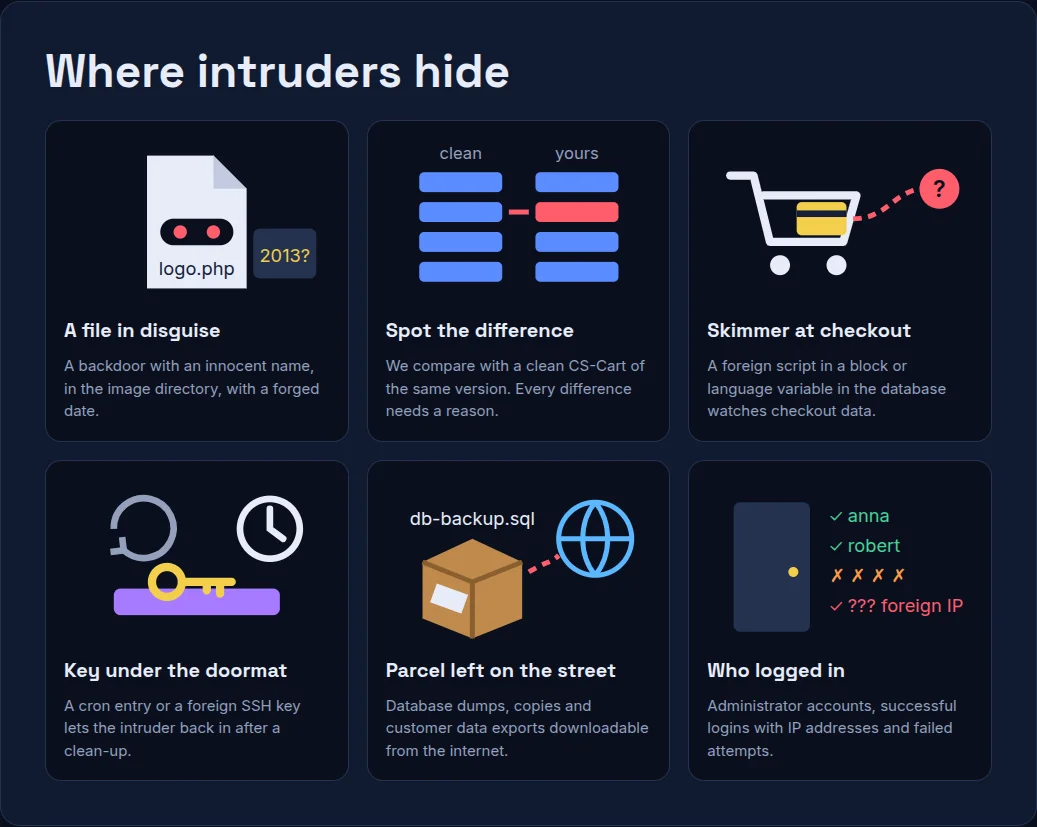
Antivirus scanners on hosting servers look for known patterns in PHP files. Backdoors in CS-Cart stores, however, can pose as ordinary store files, sit in the image directory under an innocent name and carry a forged modification date, so nothing makes them stand out in a file listing. A script that steals card data does not have to live in a file at all, because it is easier to hide it in an HTML block or a language variable in the database, from where it reaches every page of the store, checkout included.
Then there is access that survives a clean-up of the store: a cron entry on the hosting account that restores a deleted file, or a foreign SSH key. A report that looks only at the store directory can declare clean an installation that someone else still controls. That is why the audit covers files, database and hosting account together, and every statement that something is clean rests on a list of the places we actually checked.
The audit in three pictures
When an audit makes sense
These are the situations store owners most often come to us with.
- The store was hacked, or you suspect it was, because something changed in the checkout, the admin panel or search results that nobody touched.
- Your hosting company reported malicious files on the account or suspended the store, and you want to know whether deleting the listed files is enough.
- You are taking over a store from another developer and want to know what you are getting before you become responsible for it.
- The store has run for years without core, add-on or PHP updates, and nobody has checked what has piled up in the meantime.
In each case we start with the same full review, because traces of an intrusion and plain neglect look much alike at first glance.
What we check
The full scope of a one-off audit of one store installation, together with its copies on the same account.
Backdoors and malicious code in files
We look for PHP files where only data should be, such as the image directory, and for code hidden in files with unusual extensions. We scan the whole tree for known backdoor signatures and check the spread of file dates, because attackers forge modification times.
Comparison with a clean CS-Cart
We compare core files, JavaScript and admin panel templates with a clean CS-Cart or Multi-Vendor release of the same version. Every added or modified file needs an explanation, and add-ons outside the distribution are listed with a question about where they came from.
Scripts injected into the database
We search HTML blocks, descriptions, settings and language variables for foreign scripts. A language variable is rendered on every page of the store, which makes it a typical place for a checkout skimmer. We also list every domain the blocks refer to and payment methods with scripts outside the distribution.
Cron, SSH keys and the hosting account
We check cron jobs, SSH keys, shell start-up files and mail forwarding on the account. These are the places where an attacker leaves access that survives the removal of every store file.
Files exposed to the internet
We look for database dumps, archives, configuration copies, a code repository directory and exports with customer data, and for every file found we check whether it can be downloaded from the internet. We also check the protection of the var directory, copies of the store such as dev or old, and forgotten admin tools once uploaded to the store directory.
Administrator accounts and login history
We list admin panel accounts, API keys and password formats, and from the CS-Cart event log we pull failed login attempts and successful administrator logins with IP addresses. On Multi-Vendor we also check recently created vendor companies and vendor permission groups that come close to administrator rights.
PHP, HTTP headers and file permissions
We check the PHP version and settings, session cookies, security headers, the admin panel address, and files and directories writable by other users on the server. Store security settings, such as the cron password, are read together with per-storefront overrides.
Report with a remediation plan
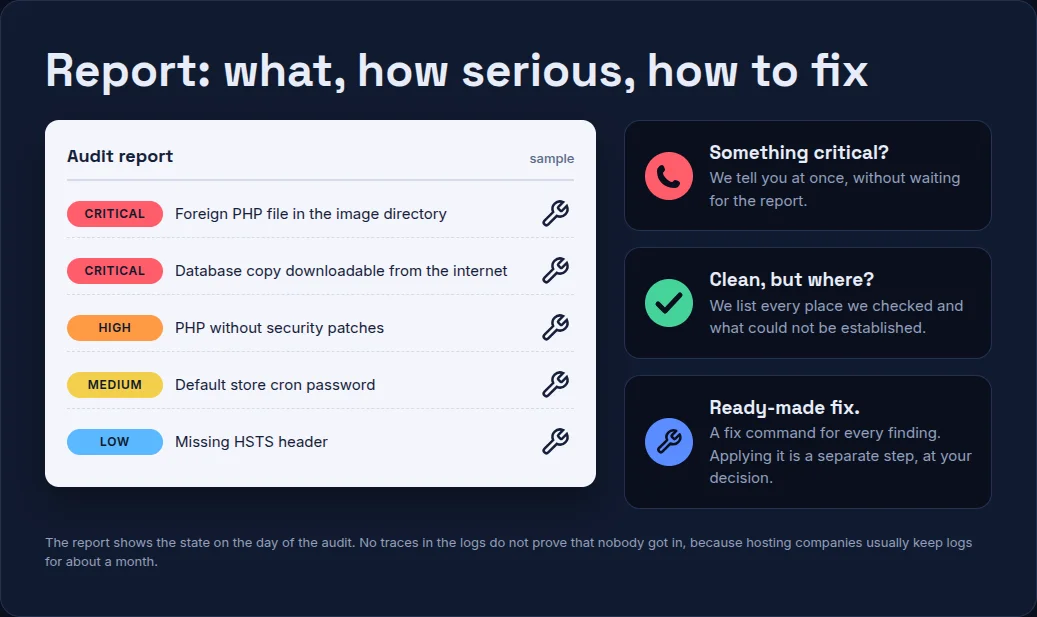
Every finding gets a severity, evidence with a file path or query result, a note on whether it is reachable from the internet, and ready-to-run fix commands. We also list separately what we checked and found clean, and what could not be established.
Pricing
Prices net of VAT, invoiced in PLN, with an approximate EUR equivalent. We confirm the final amount before you sign the order, once we know how many copies of the store sit on the account, because each copy is a separate audit target.
Audit
- Server-side store security audit One CS-Cart or Multi-Vendor installation on one hosting account, the full scope described above, a report with a remediation plan
- from 1,500 PLN (about 360 EUR)
- External view of the store Add-on to the audit: mail authentication for the store domain, headers and encryption, forgotten subdomains with store copies, leaks reachable from the internet, admin login protection
- from 500 PLN (about 120 EUR)
- Repeat audit of the same installation Comparison with the checksum record from the previous audit: what was added, removed and changed
- from 750 PLN (about 180 EUR)
After the audit
- Fixes based on the report Quoted separately after we go through the report, billed by the hour
- 250 PLN / hour
- We run the external view at a careful pace, because stores usually sit on shared hosting and the hosting firewall can block a scanner that goes too fast within minutes.
- Payment: half when you sign the order, the rest when we deliver the report.
How it works
- 1
Call and scope
We agree on the store address, the CS-Cart version, the hosting account and whether the audit includes the external view.
- 2
Authorisation
A person entitled to decide about the store signs an authorisation that names the hosting account. We verify the company in the official business register. Until then we do not run a single command on the server.
- 3
Audit
We work over SSH, read-only. If we find something critical, we report it straight away, without waiting for the report.
- 4
Report
We go through the findings and the remediation plan. You can apply the fixes yourself, hand them to your developer or order them from us.
What the audit does not cover
During the audit we fix and delete nothing, not even a backdoor we find, because changing the server is a separate decision made after we go through the report, preceded by an evidence copy. We never run code we find, and when we need to know what it does, we analyse a copy on our own machine.
The audit shows the state on the day of the review and does not guarantee that nobody will break into the store again. No traces in the logs do not prove that a backdoor was never used, because hosting companies usually keep logs for about a month and some backdoors hide their traffic. If something could not be checked, for example because the hosting gives no access to cron, the report says so plainly. The audit is not a compliance certification or a GDPR audit either.
Worth a look
CS-Cart store care
A monthly plan with updates and regular security reviews, for when you want the store under steady watch after the audit.
CS-Cart add-on written with AI
The most common security mistakes in add-ons written with AI and what to check before launch.
CS-Cart add-ons
More than 160 add-ons for CS-Cart and Multi-Vendor, from payment integrations to invoicing.
Frequently asked questions
How long does the audit take?
A typical store with a single installation takes about one working day from the moment we have access and the signed authorisation, and we deliver the report within a few business days. It takes longer on an account with store copies, because each copy is checked separately, and on a store where we find a backdoor and need to establish what it was used for.
Do you change anything on the server?
No. The audit is strictly read-only. The only trace of our work is a database reading script that we place outside the store directory just for the run and delete straight away. Fixes are listed in the report as ready-to-run commands, and we apply them only under a separate order.
What do you need from us?
SSH access to the store's hosting account and a written authorisation signed by the business owner, a board member or a person holding a power of attorney. The authorisation names the store and the hosting account, and we check the company details in the official business register. For the login test in the external view, a test account in the admin panel helps too.
What if you find something critical?
Traces of an ongoing intrusion, a foreign administrator account or a publicly accessible file with customer data are reported immediately, during the audit, not in the final report. We agree together on what has to be done right away, and the rest goes into the report like every other finding.
How is the audit different from store care?
The audit is a one-off full review with a report and no ongoing commitment. Store care is a monthly plan with a pool of hours in which we update the store, repeat the security review on a schedule and help with incidents. Many stores start with an audit and move to store care once the fixes are done.
What happens to the audit data?
We keep the results on our own machine in a restricted directory and delete them 90 days after delivering the report. Passwords and personal data we come across do not go into the report.
CS-Cart store care
Ongoing care for a CS-Cart store or Multi-Vendor marketplace: core and add-on updates, regular security reviews, code review of add-ons, including those written with AI, and help when something stops working.
See the offerOrder a store audit
Send the store address, the CS-Cart version and the reason for the audit, such as a notice from your hosting company. We will reply with the scope and price before you sign the order.
office@soft-solid.net · +48 661 661 964
SoftSolid · ul. Sportowa 14, 62-090 Rokietnica
NIP PL8421361047